
Your situation7-minute readFor Filipino medtechs moving from a hospital lab to a Gulf reference lab
Hospital lab to reference lab in the Gulf: rebuilding every bench for the licence exam
Hospital lab to reference lab in the Gulf: audit every bench, confirm your title with the authority and rebuild cold disciplines in ten weeks.
You have spent years on one or two benches in a hospital lab, such as hematology and chemistry, and you are thinking about a reference-lab post in the Gulf. The step from hospital lab to reference lab raises a practical question for the licence exam: you will be tested on every discipline in the blueprint, including the ones you have not touched in years.
This post is for that medtech. It builds a plan around a bench audit and a ten-week schedule that works alongside your current shifts. We make no claims about employers, pay or how Gulf reference laboratories operate, and the sources we use say nothing on those points.
What changes from hospital lab to reference lab?
The gap is breadth. A hospital bench builds depth in what you run daily, but the exam samples all disciplines, so the cold ones cost you points.
The published blueprints show the spread. The SCFHS Laboratory Technician exam, as published, is 150 MCQs in 3 hours, with Microbiology, Clinical Chemistry, Hematology and Blood Bank at 20% each, Immunology/Serology at 15% and Histo/Cyto-Techniques at 5%. SCFHS notes the weights may differ by up to 5% in each category and are subject to change. If you have not run blood bank crossmatches or culture work in years, that is 40% of the paper in rusty territory.
The same pattern appears on other papers. DHA's two laboratory exams list their coverage areas, and its technologist list is wide. Reading the DHA guideline takes ten minutes and tells you how wide.
Which title will the new post carry?
The title decides the exam, and a new post may carry a different title from the one you hold now. Check it with the authority before you plan, because we cannot tell you how an authority classifies a Philippine degree or experience.
Qatar's DHP lists five titles in its Laboratory Scopes document: Laboratory Technician, Laboratory Technologist (Biomedical), Laboratory Technologist (Specific), Clinical Scientist and Consultant Clinical Scientist. The sources give education and experience lines only for the first two, so for the others, check with DHP. SCFHS publishes separate Technician, Microbiology Technician and Specialist (SLLE) guides, and we found no eligibility rules there. DHA runs separate Technician and Technologist papers.
The wider papers add areas a single bench never touches. The SLLE includes laboratory operations and patient safety and professionalism at 5 to 10% each, and DHA's technologist list names laboratory operation and patient safety and professionalism too. Our guide to technician, technologist and specialist titles shows how to ask the right questions.
How do you run a bench audit?
A bench audit rates each discipline on two things, how recently you ran it and how much your blueprint weights it. Together they give you a rebuild order based on evidence and not on comfort.
List all eight disciplines the simulator covers: Blood Banking, Clinical Chemistry, Hematology, Clinical Microbiology, Immunology & Serology, Urinalysis & Body Fluids, Histopathology & Cytotechnology, and Laboratory Operations & Safety. For each, write the last time you ran it at the bench, its weight in your blueprint, and a plan. Then take one timed set per discipline to check your self-rating against a score.
The table is a sample for a medtech whose recent work was in hematology and chemistry, using the SCFHS technician weights. Replace the weights with your own authority's.
| Discipline | Last time you ran it | Weight in your blueprint | Plan |
|---|---|---|---|
| Hematology | This month | 20% (SCFHS technician) | Maintain with weekly sets |
| Clinical Chemistry | This month | 20% | Maintain; drill units and QC |
| Blood Bank | Years ago | 20% | Rebuild first |
| Microbiology | Years ago | 20% | Rebuild first |
| Immunology/Serology | Occasionally | 15% | Rebuild second |
| Histo/Cyto | Never | 5% | Short block, still counts |
How do you rebuild the benches you left?
Rebuild the cold benches in order of weight, starting from reasoning and not from memorising lists. Cold disciplines return faster when you relearn the logic, such as how ABO forward and reverse typing disagree, before the details.
Use the bench you know as an anchor. If you run hematology daily, you already read morphology and coagulation, which connects to transfusion reactions in blood bank. If you run chemistry, your QC habits carry over to microbiology susceptibility testing and to laboratory operations. Linking the new to the familiar gives you hooks. A useful test is to explain a result from your anchor bench to a colleague who works elsewhere, and then explain the matching result in the cold discipline. If you cannot do the second, you have found your next study block.
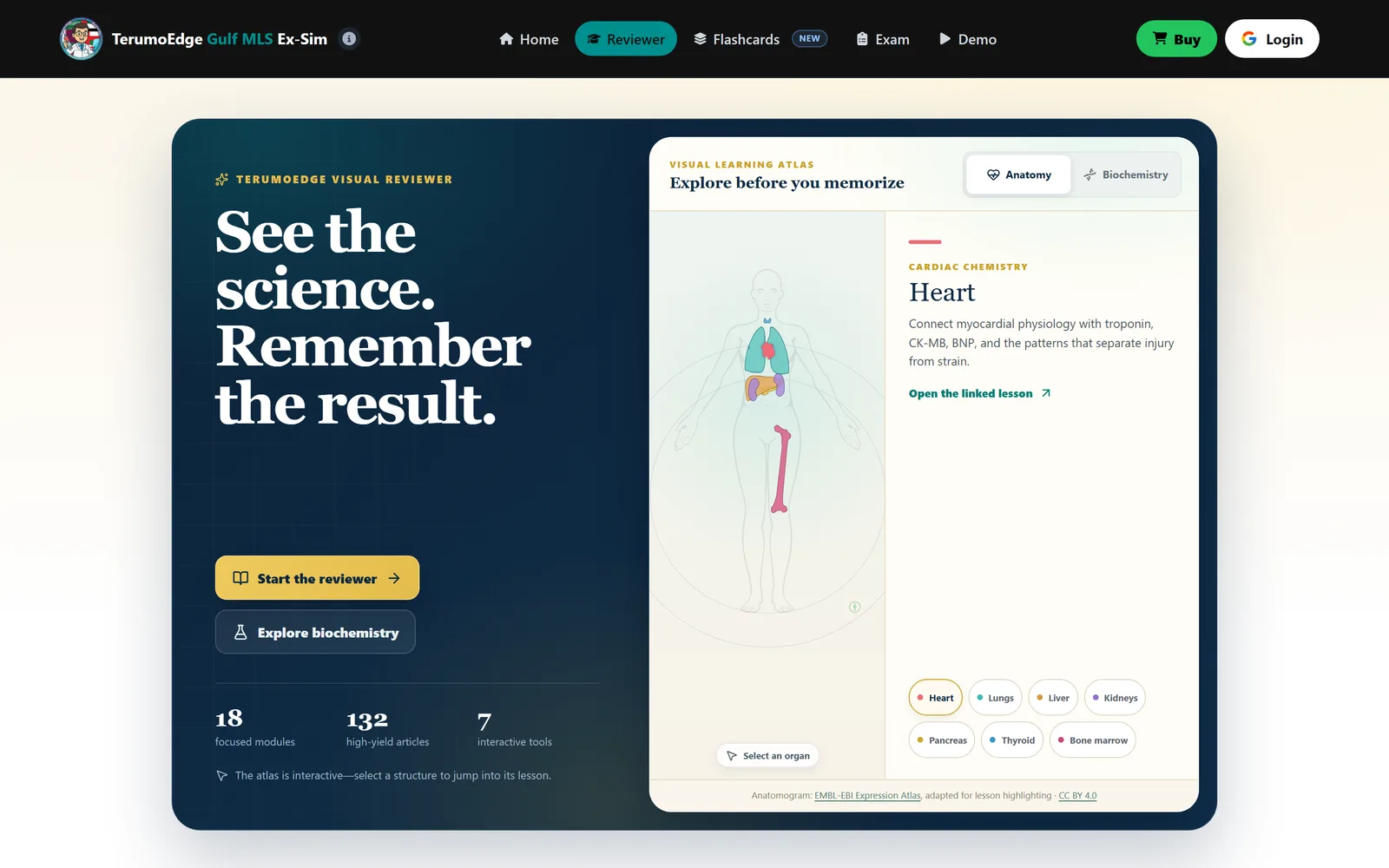
Then use practice to find out what you really remember. Run a fixed set from the discipline, read every explanation, and write down the topics you missed. The simulator has 500 items in each discipline, and the lab-science reviewer at the reviewer hub has 18 modules and 132 articles for mechanisms. That reviewer is shared across TerumoEdge's laboratory exams and is not Gulf-specific.
What about operations, safety and professionalism?
Operations, safety and professionalism are the areas a single bench rarely tests directly, so study them as their own block. They appear in the SLLE as laboratory operations and patient safety and professionalism, and DHA's technologist list names both.
Read the lists first, then relate them to what you already do. Safety covers the practices you follow every shift. Operations covers how a laboratory is run, which you meet through QC, documentation and workflow. Professionalism is the least familiar for many people because it asks you to choose the right action in a scenario, not recall a value.
Give this block a short, dedicated week and use flashcards to keep it warm. Read each scenario the way the exam will: four options, one best answer, and a stem that often asks what you should do first. Check the reasoning behind the answer in the explanation, since professionalism items are decided by principle and not by a number you can memorise. Our guide to the smaller blocks covers the other low-weight areas. These topics are worth 5 to 10% each on the SLLE as published, which is enough to move a result.
What does a ten-week plan around your current shifts look like?
A ten-week plan spends weeks one and two on the audit, weeks three to eight on rebuilding by weight, week nine on full timed papers, and week ten on taper and logistics. It assumes you keep your current job, so it uses your days off.
- Weeks 1–2: audit all eight disciplines with one timed set each. Rank them.
- Weeks 3–4: rebuild your two coldest heavy disciplines.
- Weeks 5–6: rebuild the next two, and add Immunology/Serology.
- Weeks 7–8: cover Histo/Cyto, Urinalysis, and Operations and Safety. Re-test the first two.
- Week 9: two full timed papers at 72 seconds an item, using the 100-item mock set to 120 minutes.
- Week 10: a light set, error-note review, paperwork and rest.
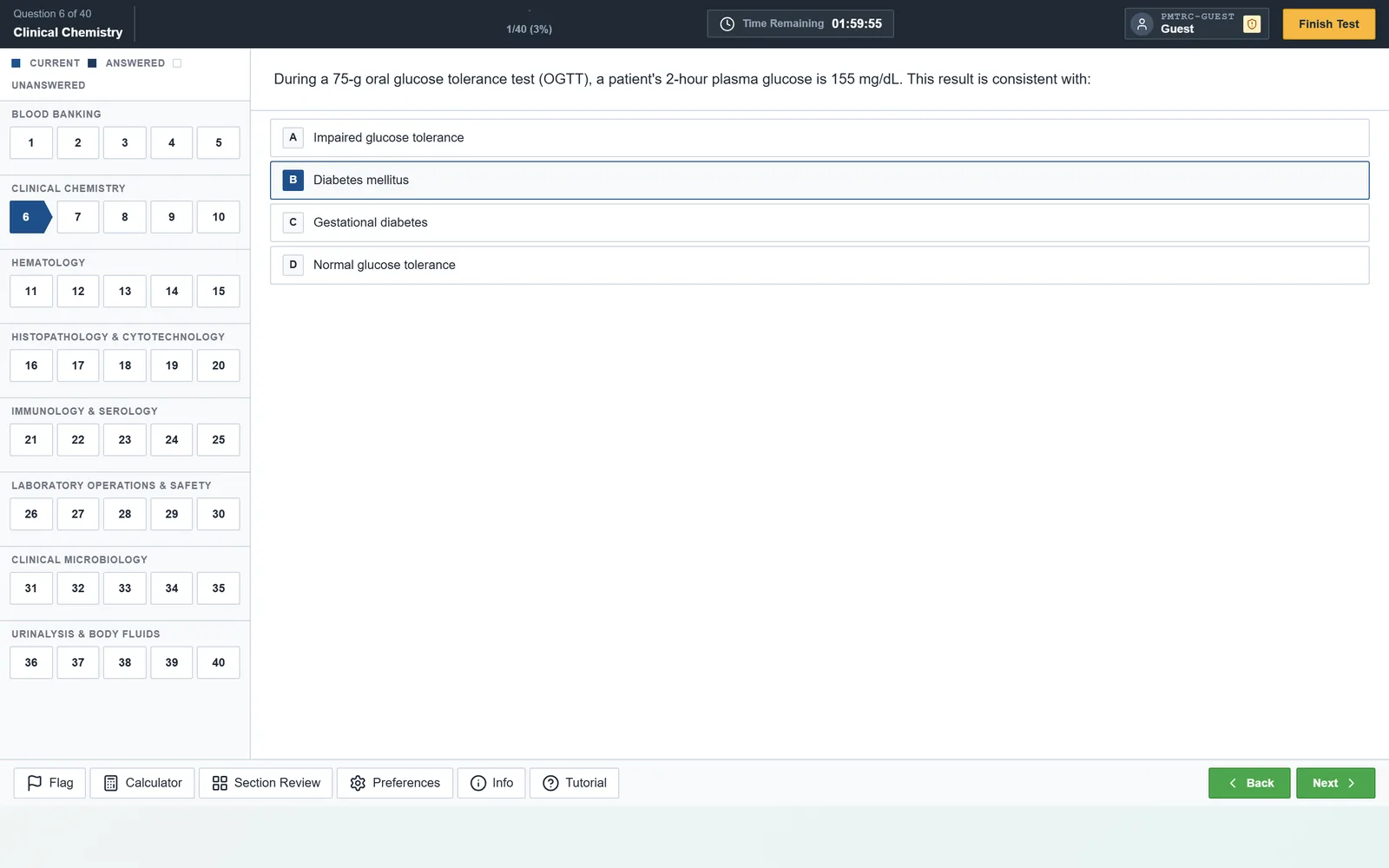
Fit the weekly sessions to your roster using our working medtech schedule. Try the free demo with its 40 items to see the format, though it is unscored. Nothing here promises a result, and the weeks can stretch if your roster is heavy. If you need to move a date, check the booking terms first, because the sources we use contain no rescheduling rules.
Frequently asked questions
I have only worked in hematology. Can I still pass?
We cannot promise a result, and no authority we found publishes pass rates. The exam covers every discipline in its blueprint, so the work is rebuilding the others. A bench audit, a ten-week plan and timed practice by discipline give you a structured way to do that.
Does reference-lab experience change which exam I take?
The title you apply for decides the exam, so check with the authority which title your qualifications and experience fit. The sources we use do not say how an authority treats reference-lab experience. Qatar's DHP lists extra titles, such as Clinical Scientist, with no requirements in the sources we have.
Which disciplines go cold first?
We have no data on that. Think of it as the disciplines you have not run recently. For a hospital medtech on two benches, that is usually everything else, so the bench audit asks you to rate each one honestly and test the rating with a timed set.
Is the simulator a reference-lab product?
No. TerumoEdge Gulf MLS Ex-Sim is a practice simulator for the Gulf laboratory licensing exams, with 4,000 items across eight disciplines. It makes no claims about how any laboratory operates, and its mock is one blended paper, not any authority's own.
Sources
- Laboratory Technician Blueprint, Saudi Licensing Examinations — SCFHS
- Saudi Laboratory Specialist Licensure Examination (SLLE) Content Guideline — SCFHS
- Healthcare Professional Licensing Assessment Guideline, Computer Based Testing — Dubai Health Authority
- Laboratory Scopes — Department of Healthcare Professions, Qatar
From the publisher
Practise the lab disciplines first.
TerumoEdge Gulf MLS is a practice simulator for the Gulf laboratory licensing exams: timed sessions in eight lab disciplines, an adjustable clock, and a full explanation for every item instead of a bare answer key.
- 4,000 items, 500 in each of eight lab disciplines
- A 100-item blended mock, reshuffled each attempt
- A full English explanation for every item, with the reason each wrong option is wrong
- A lab science reviewer and flashcards beside the question bank
Try the free Gulf MLS simulator demo Forty items across all eight lab disciplines. No account needed.
About this article
Written by the TerumoEdge editorial team, who build the TerumoEdge Gulf MLS Ex-Sim. Exam facts are checked against the published documents of SCFHS, the Dubai Health Authority, Qatar's Department of Healthcare Professions and NHRA Bahrain, and every article lists its sources. How we write and check our articles.
First published .