
Guides7-minute readFor medtechs tempted to skip the smaller blocks
Immunology and serology, histo/cyto and the other small blocks of the Prometric lab exam
Immunology and serology for the Prometric lab exam, plus histo/cyto, urinalysis and lab operations: which list names which block, and a one-week method.
Immunology and serology, histo/cyto, urinalysis and lab operations are the blocks candidates are tempted to skip, because each is worth less than a big discipline. Add them up and they are not small. On one SCFHS list they are a fifth of the paper, and on another they are five separate sections. This guide settles which blocks apply to you and gives an efficient method for each.
We tie every figure to the authority's own document. Where a list is silent, we say so.
Why do the small blocks carry real points?
The small blocks are worth more together than any one of them suggests. The SCFHS Laboratory Technician blueprint gives Immunology/Serology 15% and Histo/Cyto-Techniques 5% of 150 items, so about 30 items between them. SCFHS notes the weights can differ by up to 5% and can change.
The SLLE lists urinalysis and body fluids, immunology and serology, histo/cyto, laboratory operations, and patient safety and professionalism at 5-10% each. DHA's technologist list names the same family of subjects, but publishes no weights.
The SCFHS technician blueprint does not list urinalysis or laboratory operations as categories, whereas the SLLE and DHA technologist lists do. Know which list is yours before you decide where to spend time.
| Block | SCFHS technician | SLLE | DHA technologist list | Efficient method |
|---|---|---|---|---|
| Immunology and serology | 15% | 5-10% | Named | Titre arithmetic, test principles, marker panels |
| Histo/cyto | 5% | 5-10% | Named | Learn the processing sequence and stain-to-target pairs |
| Urinalysis and body fluids | Not a listed category | 5-10% | Named | Casts, crystals, dipstick logic, fluid cell counts |
| Laboratory operations | Not a listed category | 5-10% | Named (laboratory operation) | Process and QC vocabulary |
| Patient safety and professionalism | Not a listed category | 5-10% | Named | Ethics and safety scenarios |
DHA's technician list also names immunology, immunology/serology and urinalysis. Read your own list line by line.
How should you review immunology and serology?
Review immunology and serology by test principle and by marker pattern, not by memorising kit names. Start with the antibody-antigen reaction itself: agglutination, precipitation, complement fixation, and labelled methods such as ELISA. In a sandwich ELISA, signal rises with antigen. In a competitive ELISA, signal falls as the analyte rises.
Titres are free arithmetic. A serial doubling dilution starting at 1:2 gives 1:4, 1:8, 1:16 and so on.
Know the syphilis pair: nontreponemal tests (RPR, VDRL) are screening tests that can give biological false positives, while treponemal tests (such as TP-PA and FTA-ABS) confirm. Know the hypersensitivity types I to IV with one example each. Know the autoimmune markers by disease: anti-dsDNA with lupus, anti-CCP with rheumatoid arthritis, anti-centromere with limited scleroderma. For hepatitis B and other viral markers, see the interpretation example in our microbiology guide.
What do you need for histotechniques and cytology?
For histotechniques, memorise the sequence, because most questions ask what comes next or what goes wrong. Tissue is fixed (10% neutral buffered formalin), dehydrated in graded alcohols, cleared (commonly in xylene), infiltrated with paraffin, embedded, cut on a microtome and stained. Calcified tissue needs decalcification before processing.
Then learn stain-to-target pairs. H&E is the routine stain. PAS shows glycogen and fungi. Ziehl-Neelsen shows acid-fast bacilli. Prussian blue shows iron. Masson trichrome shows collagen. Congo red shows amyloid, which looks apple-green under polarised light.
Errors have causes you can reason out. Incomplete dehydration gives soft, poorly cut sections. Too-long fixation hides antigens. Air bubbles or wrinkles show up at cutting or mounting.
For cytology, know the Papanicolaou stain, the need for immediate wet fixation (commonly with alcohol) to preserve nuclear detail, and the idea of a standardised reporting system for cervical cytology. At 5% of the SCFHS technician paper, this block is cheap to cover well.
How do you handle urinalysis and body fluids?
Urinalysis and body fluids are pattern recognition on a few objects: casts, crystals, cells and chemistry strips. Learn the casts by what makes them. Hyaline casts can be normal. Red cell casts point to glomerular bleeding. White cell casts point to kidney infection or inflammation. Waxy casts suggest long-standing renal stasis.
For the chemical strip, remember what each pad detects and what interferes: for example, ketones appear in uncontrolled diabetes and fasting, and bilirubin and urobilinogen separate obstructive from haemolytic patterns. Crystals depend on urine pH, so know which form in acid and which in alkaline urine.
For body fluids, learn the transudate-versus-exudate split. By Light's criteria, a pleural fluid is an exudate if the fluid-to-serum protein ratio is above 0.5, the fluid-to-serum LDH ratio is above 0.6, or fluid LDH is above two-thirds of the serum upper limit. CSF questions revolve around cell counts, appearance and the common pathogens by pattern.
What does laboratory operations, safety and professionalism cover?
These sections cover how a laboratory runs safely and ethically, and they reward plain judgement. Learn the vocabulary: standard precautions, specimen identification and chain of custody, labelling, hazard communication, sharps and waste handling, critical-value notification and documented corrective action when a control fails.
Patient safety and professionalism is scenario-based. Typical themes are patient identification, confidentiality of results, reporting an error instead of hiding it, working within your scope, and responding to an unsafe situation. The correct option is almost always the one that protects the patient, follows the documented procedure and escalates when needed.
A worked pattern helps. If a tube is labelled with the wrong patient name, the answer is never to relabel it quietly. You reject the specimen, tell the person responsible, document the event and request a new sample. Practise reading each scenario for three things: who could be harmed, what the written procedure says, and who must be told. Those three questions settle most professionalism items before you read the options a second time.
The wording differs by list. The SLLE names "laboratory operations" and "patient safety and professionalism" as separate sections. DHA's technologist list names "laboratory operation" and "patient safety and professionalism". If you come from a bench-only background, our hospital lab to reference lab guide shows how to rebuild these topics.
What does a one-week small-blocks plan look like?
One focused week covers all five blocks if you drill them in short sessions. A phone-sized session of 20 to 30 minutes is enough for most days.
- Day 1: immunology and serology principles and titre arithmetic.
- Day 2: serology marker panels, then 100 items from a fixed Immunology & Serology set.
- Day 3: histo processing sequence and stain pairs, then cytology.
- Day 4: urinalysis and body fluids.
- Day 5: laboratory operations, safety and professionalism scenarios.
- Day 6: a mixed timed set across all five blocks.
- Day 7: rest, or review only your missed flashcards.
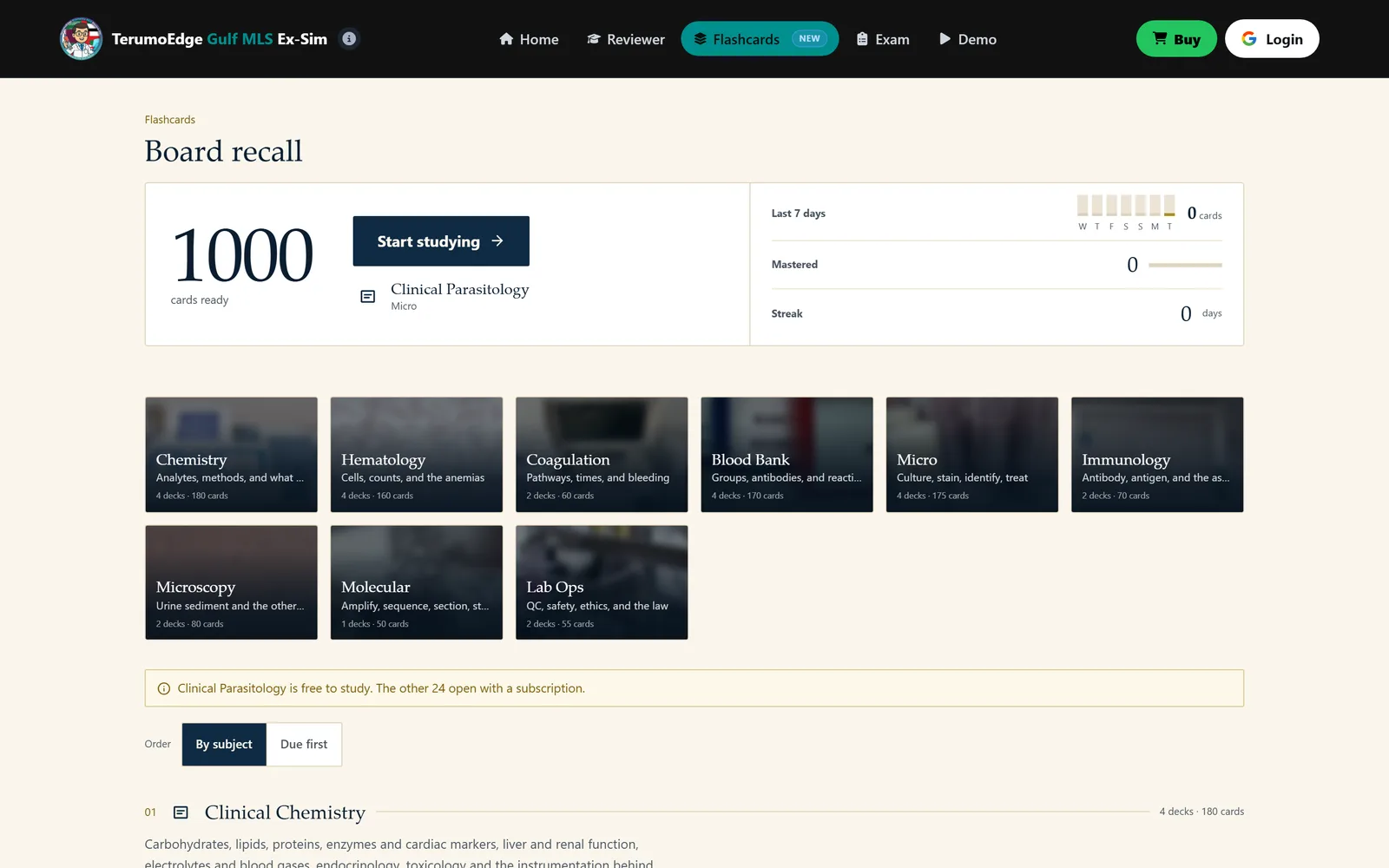
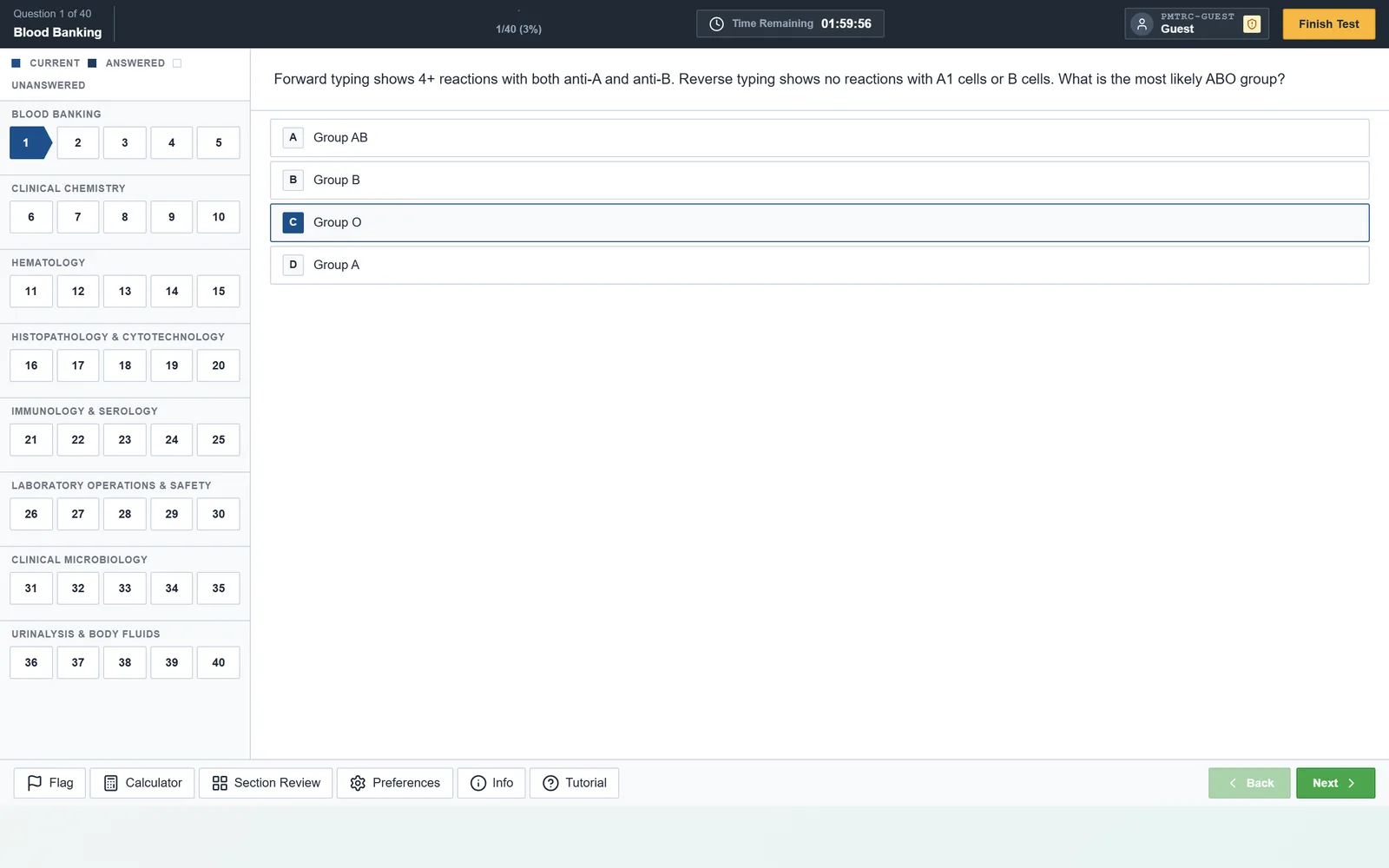
The bank holds 500 items in each of Immunology & Serology, Urinalysis & Body Fluids, Histopathology & Cytotechnology, and Laboratory Operations & Safety. The Full Mock draws 7 items from each, which is the product's blend and not any authority's paper. Fit the week into the eight-week plan, and try the free demo first.
Frequently asked questions
Can I skip histopathology?
It is risky. Histo/Cyto-Techniques is 5% of the SCFHS technician blueprint, about 7 items of 150, and 5-10% of the SLLE. Skipping gives away easy, memorisable points. A short block built on the processing sequence and stain pairs is far cheaper than the marks it protects.
Is urinalysis on the Prometric exam?
It depends on the list. The SLLE has a urinalysis and body fluids section at 5-10%. DHA's technician and technologist lists both name urinalysis. The SCFHS Laboratory Technician blueprint does not list it as a category. Read your authority's current document to see which applies.
What does patient safety and professionalism cover?
The SLLE and DHA's technologist list both name it, but neither document in our sources breaks it down. In general it covers patient identification, confidentiality, reporting errors, working within your scope and safe practice. Check your authority's guideline for its exact wording.
Is immunology and serology a large block?
On the SCFHS Laboratory Technician blueprint it is 15%, about 22 of 150 items. On the SLLE it is 5-10%. DHA names it on both papers without a weight. Treat it as a mid-sized block with predictable arithmetic and pattern questions.
Sources
From the publisher
Practise the lab disciplines first.
TerumoEdge Gulf MLS is a practice simulator for the Gulf laboratory licensing exams: timed sessions in eight lab disciplines, an adjustable clock, and a full explanation for every item instead of a bare answer key.
- 4,000 items, 500 in each of eight lab disciplines
- A 100-item blended mock, reshuffled each attempt
- A full English explanation for every item, with the reason each wrong option is wrong
- A lab science reviewer and flashcards beside the question bank
Try the free Gulf MLS simulator demo Forty items across all eight lab disciplines. No account needed.
About this article
Written by the TerumoEdge editorial team, who build the TerumoEdge Gulf MLS Ex-Sim. Exam facts are checked against the published documents of SCFHS, the Dubai Health Authority, Qatar's Department of Healthcare Professions and NHRA Bahrain, and every article lists its sources. How we write and check our articles.
First published .