
Study strategy7-minute readFor medtechs planning a Gulf exam review
An eight-week Prometric exam study plan, weighted to your authority's own blueprint
An eight-week Prometric exam study plan for medtechs: hours split by the SCFHS blueprint, swaps for the SLLE and DHA lists, timed rehearsals and a taper.
An eight-week Prometric exam study plan works when it is built from your authority's own blueprint, not from a generic syllabus. This plan uses the SCFHS Laboratory Technician weights as its worked example, then shows how to swap in the SLLE ranges or DHA's lists. It does not promise a result. Eight weeks suits some candidates and not others, and the plan flexes with your starting point.
The hours below assume 18 hours a week. If you have fewer, keep the proportions and stretch the weeks. Shift workers should read our guide to reviewing while working alongside this one.
How do you start from your authority and your title?
Start by writing down which exam you are sitting, because each authority publishes a different paper. The SCFHS Laboratory Technician exam is 150 MCQs in 3 hours with a 55% passing score. The SLLE is 200 items in two 120-minute parts. DHA's papers are 150 questions in 3 hours at a 50% pass score, with coverage lists instead of weights.
Then read the guide for that exam. These figures can change, so use the authority's current document.
Plan the paperwork in parallel. DHA requires an Eligibility ID before you can book, and NHRA Bahrain issues an eligibility code after your online application is approved. Open the file now, since no seat can be booked until that step clears. Our exam day guide covers the sequence.
How do you build a Prometric exam study plan by weight in weeks 1 to 6?
Split the first five weeks by blueprint weight and keep week 6 for repair. With the SCFHS technician weights (Microbiology 20, Clinical Chemistry 20, Hematology 20, Blood Bank 20, Immunology/Serology 15, Histo/Cyto 5), weights in this plan may shift by up to 5% in any category, as SCFHS notes.
| Week | Focus | Target hours (18 a week) |
|---|---|---|
| 1 | Blood Bank | 18 (20% block) |
| 2 | Hematology | 18 (20% block) |
| 3 | Clinical Chemistry | 18 (20% block) |
| 4 | Clinical Microbiology | 18 (20% block) |
| 5 | Immunology/Serology and Histo/Cyto | 13.5 and 4.5 (15% and 5% of 90) |
| 6 | Repair: your weakest disciplines | 18, spent where week 1-5 sets scored lowest |
| 7 | Full timed rehearsals | 18 |
| 8 | Taper and logistics | 8 to 10 |
The arithmetic is simple. Five blocks at 90 hours total, with each weight taking its share of 90: 20% is 18 hours, 15% is 13.5 hours and 5% is 4.5 hours.
Each weekly block follows one pattern: read or watch the topic map first, then do a fixed set of 100 items, read the explanation for every miss, and finish with flashcards. The discipline guides help: blood bank and hematology, clinical chemistry, microbiology and the small blocks.
How do you find your weak spots before week 6?
Find them from data, not from feeling. After each weekly block, note your score on that discipline's fixed set and the reason for every miss: a knowledge gap, a misread stem, a unit slip or a rushed guess. Those four causes need different fixes, and mixing them up wastes the repair week.
A knowledge gap needs the topic map again. A misread stem needs slower reading of the question line. A unit slip needs conversion drills, and a rushed guess needs pace practice. Count each cause across the five weeks, then spend week 6 on the two disciplines with the most misses and the cause that appears most.
Do not repair by re-reading what you already know. Retest the same fixed set a week later, and use the random pool to confirm the gap closed on items you have not seen. The 100-item sets make that comparison fair.
How do you swap in the SLLE ranges or the DHA lists?
Swap by replacing the weight column and keeping everything else. The SLLE gives ranges, not points: Blood Bank, Clinical Chemistry, Hematology and Microbiology are 15-20% each, and Urinalysis and Body Fluids, Immunology and Serology, Histo/Cyto, Laboratory Operations, and Patient Safety and Professionalism are 5-10% each.
Allocate hours inside each range, giving the upper end to the disciplines where your self-test scores are lowest. You also have more categories than the technician paper, so the small blocks need real hours. A common mistake is treating five 5-10% sections as one afternoon.
DHA publishes coverage lists with no weights. With no weights to use, treat every named discipline as a block, split your time roughly evenly, and then shift hours toward your weakest. Do not borrow SCFHS percentages for DHA, because that would be a guess dressed up as a weight.
What happens in week 7: full timed rehearsals?
Week 7 is for exam conditions: a full session, a real clock, no pausing. The product has one blended mock of 100 items, reshuffled each attempt, drawing 18 items each from Blood Banking, Clinical Chemistry, Hematology and Clinical Microbiology and 7 each from the other four. That blend is the product's design, not any authority's paper, and there is no separate mock per authority.
To train the pace of a 150-item, 3-hour paper (72 seconds an item), set the mock to 120 minutes. The default is 150 minutes, which is generous and matches no authority's paper. The time management guide explains the arithmetic.
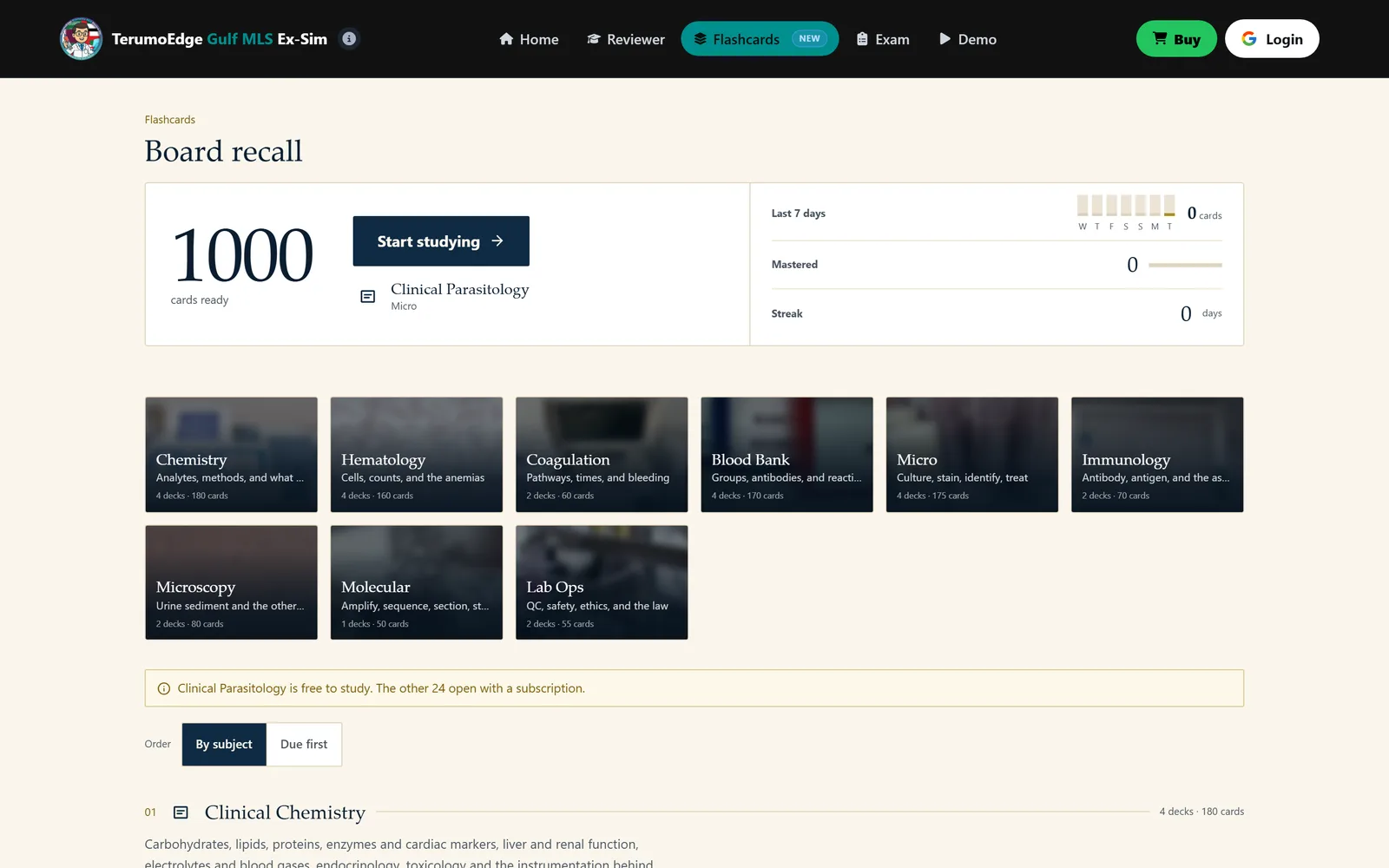
Use the other tools to vary the practice. Each discipline has four fixed sets plus a random pool of 100 items drawn from all 500, so you can stack two or three disciplines back to back for endurance. Review misses afterwards the same day.
What do you do in week 8?
Week 8 is a taper: lighter review, no new topics and a finished logistics list. Review your own error log, your flashcards and the explanations of items you missed twice. Stop stacking new material, because tired recall costs more than a fresh gap.
Logistics belong here too. For DHA, the manual says to arrive 30 minutes early and to bring a passport whose name matches your Sheryan account. For any authority, follow your appointment confirmation. Our last-month guide goes deeper on the final stretch.
What does a sample study day look like?
A sample day on 18 hours a week is about two and a half hours, with a split between learning and testing. Adjust the clock times to your shift.
| Block | Minutes | What you do |
|---|---|---|
| Warm-up | 15 | Flashcards from yesterday's misses |
| Topic map | 45 | Read the discipline guide or the lab science reviewer module at /learn/ |
| Timed set | 50 | 40 to 50 items from the current discipline at 72 seconds each |
| Explanations | 30 | Read the reasoning for every miss, and write one line per miss |
| Cool-down | 10 | Update the error log |
If the whole day is not available, drop the topic map before you drop the timed set. On a night-shift week, move the block to the evening before duty and keep the explanations for a short phone session afterwards. Consistency across the eight weeks matters more than any single perfect day, so a shortened day that still includes a timed set beats a skipped one. Testing under a clock is the part that is hardest to do alone.
Frequently asked questions
Is eight weeks enough for the Prometric exam?
It depends on your starting point, how recently you ran each bench and how many hours you can give. No source supports a promise either way, and no authority publishes pass rates. Eight weeks at about 18 hours a week is a realistic template. Stretch it if you have fewer hours.
How many hours a day should I study?
Aim for a steady load you can repeat, such as two to three hours on most days, not a few long binges. The plan above assumes 18 hours a week. On rotating shifts, short phone sessions plus one longer session on a day off often work better than a fixed daily slot.
When should I start full mocks?
Start full timed sessions in week 7, after you have covered every discipline once. Before that, use fixed sets and the random pool by discipline so you can see which blocks are weak. Since the product has one mock, space your mock attempts and read every explanation each time.
Sources
- Laboratory Technician Blueprint (Saudi Licensing Examinations) - SCFHS
- Saudi Laboratory Specialist Licensure Examination (SLLE) Content Guideline - SCFHS
- Healthcare Professional Licensing Assessment Guideline, Computer Based Testing - Dubai Health Authority
- Manual for Professional Assessment (Oral/CBT) v1.1 - Dubai Health Authority
- Licensure Exams - National Health Regulatory Authority, Bahrain
From the publisher
Practise the lab disciplines first.
TerumoEdge Gulf MLS is a practice simulator for the Gulf laboratory licensing exams: timed sessions in eight lab disciplines, an adjustable clock, and a full explanation for every item instead of a bare answer key.
- 4,000 items, 500 in each of eight lab disciplines
- A 100-item blended mock, reshuffled each attempt
- A full English explanation for every item, with the reason each wrong option is wrong
- A lab science reviewer and flashcards beside the question bank
Try the free Gulf MLS simulator demo Forty items across all eight lab disciplines. No account needed.
About this article
Written by the TerumoEdge editorial team, who build the TerumoEdge Gulf MLS Ex-Sim. Exam facts are checked against the published documents of SCFHS, the Dubai Health Authority, Qatar's Department of Healthcare Professions and NHRA Bahrain, and every article lists its sources. How we write and check our articles.
First published .