
Study strategy7-minute readFor medtechs in the final month before a Gulf exam
Prometric exam tips for medtechs: the last 30 days, from full rehearsals to a steady exam morning
Prometric exam tips for medtech in the final month: full rehearsals, weak-discipline repair, a taper, exam-morning logistics and a plan for nerves.
The last month before your Gulf licence exam has one job: turn what you already know into marks under a clock. These Prometric exam tips for medtech are built for that window. They assume you have covered the syllabus once and now need to rehearse, repair and arrive steady.
We cannot tell you what is on your paper, and we do not know which authority you are sitting. So the plan below works from your own results and your own authority's published blueprint. Where an authority's rule matters, we name it and keep it separate from the others.
What are the best Prometric exam tips for medtech in the last month?
The last month is for converting knowledge into timed, accurate answers. By now, new topics return less than fixing the topics you already half-know. Your gains come from three things: rehearsing at the real pace, repairing the disciplines where your timed scores are weakest, and keeping the small blocks warm.
Start by writing down your authority and your paper. The SCFHS Laboratory Technician paper, as published, is 150 MCQs in 3 hours with a 55% passing score. DHA and Qatar DHP publish 150 items in 3 hours with 50%. The SCFHS specialist exam is a different shape, with 200 items in two 120-minute parts and a pass score of 530 on a 200–800 scale. These figures come from the SCFHS technician blueprint, and authorities can change them.
Week four out: what do you set up first?
Four weeks out, take one full diagnostic paper and settle the paperwork. The diagnostic gives you a map; the paperwork removes a source of worry before it can grow. Do both in the first three or four days.
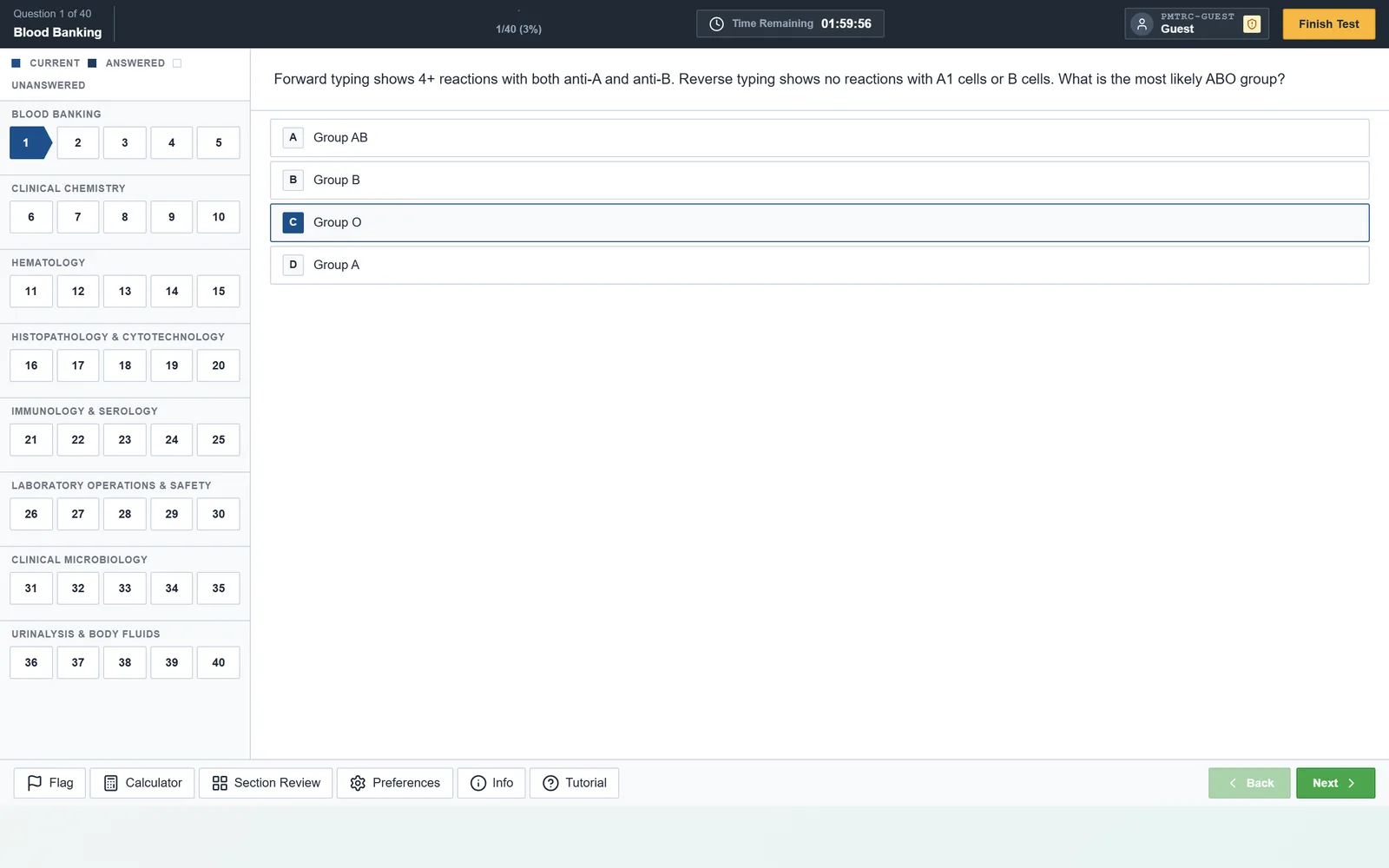
For the diagnostic, sit a full-length paper in one go, with no phone and no notes. In the TerumoEdge simulator you can set the 100-item mock to 120 minutes, which trains 72 seconds an item. That mock is our own blend of the disciplines, not any authority's paper, so read your result by discipline and ignore the total. The free demo has 40 items if you want a first feel for the format, though it is unscored.
For the paperwork, check where you stand. DHA candidates need a Sheryan account, a DHA Unique ID and an Eligibility ID before booking, as the DHA assessment guideline sets out. Other authorities have their own steps; the exam-day guide walks through them.
Week three out: how do you repair weak disciplines?
Repair weak disciplines by taking your three lowest diagnostic results and working each as a short block of timed practice followed by explanation review. Three weeks out is early enough to change a score and late enough that you should stop collecting new resources.
For each weak discipline, run a fixed set from the simulator, which gives you the same 100 items every attempt so you can see real improvement. Then read the explanation for every miss, including the options you got right by luck. Each item's explanation names the correct answer, gives the rationale and says why each other option is wrong, which is where most of the repair happens.
Weight your time by your blueprint. On the SCFHS technician paper, Microbiology, Clinical Chemistry, Hematology and Blood Bank are 20% each, so a weakness there costs the most. The published weights may differ by up to 5% in each category and are subject to change, so treat them as a guide to proportion, not a promise.
Week two out: what about the small blocks?
Spend week two on full rehearsals and on the small blocks you have been neglecting. Immunology and serology, histotechniques, urinalysis and body fluids, and laboratory operations are worth fewer points each, yet they add up, and they are the easiest to forget.
Do two full papers this week, spaced at least three days apart, at exam pace. After each, spend more time on review than you spent on the paper. Between them, use flashcards for recall. The product has 1,000 cards in 25 decks, and ten minutes a day is enough to keep a block alive.
If your authority publishes no weights, such as DHA, do not invent them. DHA lists topics, not percentages, so cover every listed area evenly and let your own results decide where to dig. A lab-science reviewer at the reviewer hub is useful here when a miss reveals a gap in the mechanism, not just in the fact.
Exam week and the morning itself
In exam week, taper. Do one light timed set early in the week, review your error notes, and stop heavy study about 24 hours before the exam. You are protecting sleep and focus now, and there is little to gain from cramming.
Here is the week in table form.
| Week | Do | Do not |
|---|---|---|
| Four out | One full diagnostic paper; check eligibility and booking | Buy new resources or start new topics |
| Three out | Repair your three weakest disciplines with timed sets and explanation review | Re-read whole textbooks |
| Two out | Two full papers at exam pace; flashcards for the small blocks | Take a paper the day before another |
| Exam week | One light set; read your error notes; pack documents | Pull an all-night session |
| Exam morning | Eat, travel with time to spare, follow your appointment confirmation | Check last-minute facts on your phone in the queue |
For DHA, the Dubai Health Authority manual says to arrive 30 minutes early, and the passport must match the name on your Sheryan account. DHA's 3 hours also include registration and the process introduction, so your answering time is shorter than the headline. Follow your own appointment confirmation for everything else. The same applies to what you carry: the one sourced rule we can quote is the passport for DHA, so do not rely on a list from a forum.
When nerves take over
Nerves are normal, and the most reliable remedy is rehearsal. Each timed paper you finish teaches your body that the clock is survivable. Over several papers, the first-item jolt shrinks.
Build a reset routine and use it in every rehearsal so it is automatic on the day. One workable version: when you notice your mind blank, take your hand off the mouse, breathe out slowly for a count of six, read the stem again from the first word, and eliminate two options before you decide. Flag an item and move on if it still will not open. Blanking halfway through 150 items usually passes within a minute if you stop fighting it.
Look after the basics: regular sleep in the last week, meals, water, and some movement. If worry is keeping you awake for several nights, or you feel panic that rehearsal and rest do not ease, please talk to a doctor or a qualified mental health professional. Seeking support is a sound part of preparing, not a sign that you are unready.
How should attempt limits shape this month?
Attempt limits are a reason to take this month seriously, not a reason to freeze. DHA allows three attempts in total, and Qatar's DHP allows five consecutive attempts, as published. Other authorities' rules were not found in the sources we use, so check with your authority.
We keep the details in our retake guide, because you do not need to carry them into the exam room. What matters now is that a properly rehearsed first attempt protects your time. Sit when your timed papers say you are ready, and use the booking terms to understand whether you can move a date if you are not.
Frequently asked questions
Should I study the night before?
Keep it light. A short skim of your error notes and flashcards for 30 to 45 minutes is fine, but a long session costs you the sleep that supports recall the next day. Pack your documents, plan your travel, and stop early enough to rest. Our guide to pacing covers the clock if you want one more thing to review.
How do I stop blanking halfway through 150 items?
Rehearse it. Use a fixed reset routine in every timed paper: breathe out slowly, re-read the stem from the first word, eliminate two options, and flag the item if it stays stuck. Practising this under a real clock makes it automatic when your pulse is up.
Can I move my exam date if I am not ready?
The sources we use contain no rescheduling rules, so we cannot say. Read the terms on your booking confirmation, and ask your authority or the test centre what they allow before you rely on moving a date. Do not assume a change is free or possible.
How many full papers should I sit in the last month?
There is no fixed number, and we cannot promise a result. A reasonable pattern is one diagnostic in week four, one or two per week after that, and none in the final two days. What matters more is the time you spend reviewing each paper.
Sources
- Laboratory Technician Blueprint, Saudi Licensing Examinations — SCFHS
- Healthcare Professional Licensing Assessment Guideline, Computer Based Testing — Dubai Health Authority
- Manual for Professional Assessment (Oral/CBT) — Dubai Health Authority
- Qualifying Examination — Department of Healthcare Professions, Qatar
From the publisher
Practise the lab disciplines first.
TerumoEdge Gulf MLS is a practice simulator for the Gulf laboratory licensing exams: timed sessions in eight lab disciplines, an adjustable clock, and a full explanation for every item instead of a bare answer key.
- 4,000 items, 500 in each of eight lab disciplines
- A 100-item blended mock, reshuffled each attempt
- A full English explanation for every item, with the reason each wrong option is wrong
- A lab science reviewer and flashcards beside the question bank
Try the free Gulf MLS simulator demo Forty items across all eight lab disciplines. No account needed.
About this article
Written by the TerumoEdge editorial team, who build the TerumoEdge Gulf MLS Ex-Sim. Exam facts are checked against the published documents of SCFHS, the Dubai Health Authority, Qatar's Department of Healthcare Professions and NHRA Bahrain, and every article lists its sources. How we write and check our articles.
First published .