
Guides6-minute readFor medtechs reviewing Clinical Chemistry
Clinical chemistry for the Prometric exam: a 20% block, and the units trap
How to review clinical chemistry for the Prometric exam: weights by authority, organ panels, QC rules, and worked unit and calculation examples.
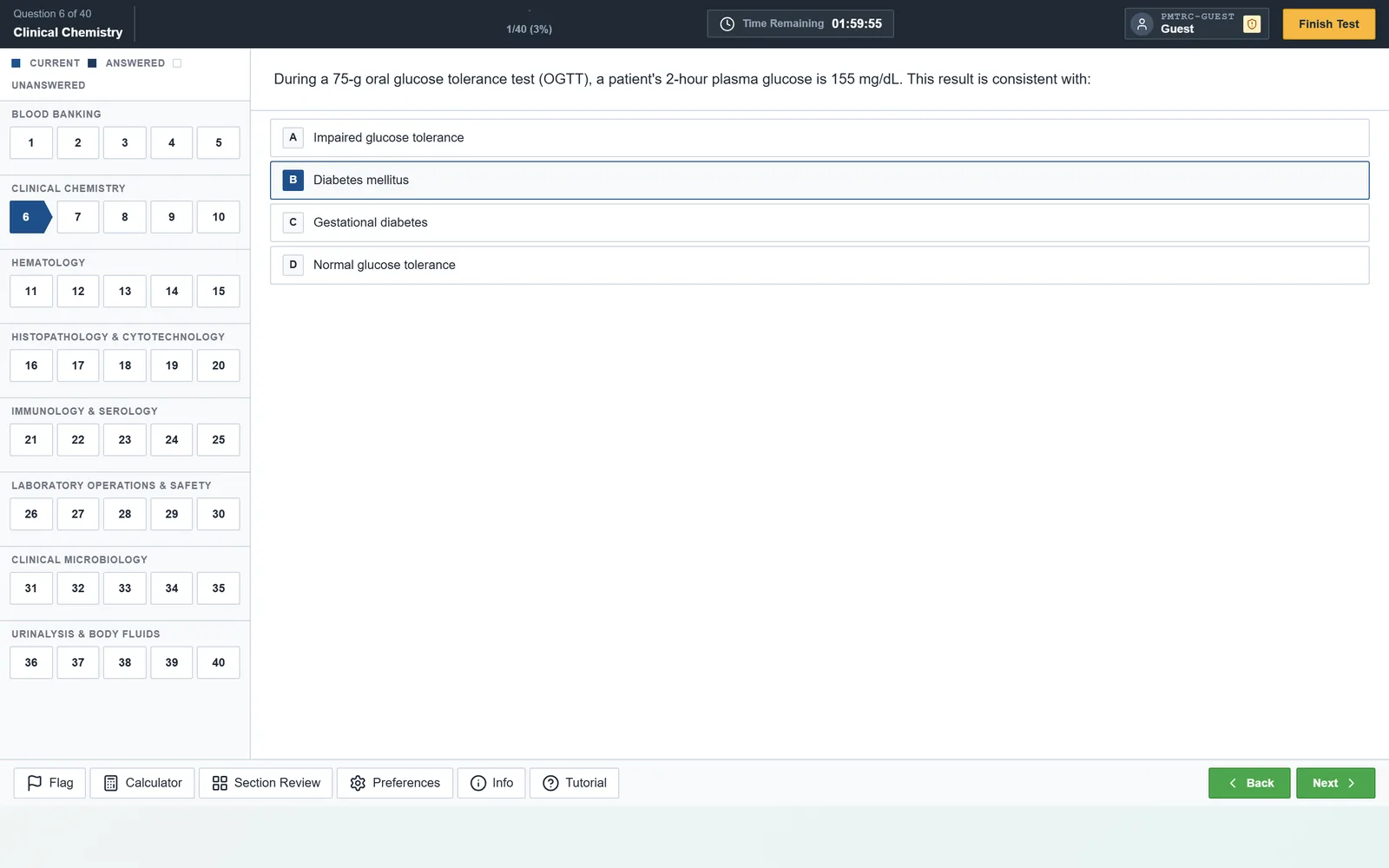
Clinical chemistry is where careful medtechs lose marks to carelessness, not ignorance. A glucose in mmol/L read as mg/dL, a creatinine in micromoles, a QC rule half-remembered: each costs the same one mark as a hard question. This guide shows how to review clinical chemistry for the Prometric exam by pattern, with worked calculations you can check.
It covers the weights each authority publishes, the organ-panel method, instruments and QC, and the units trap that gives this block its reputation.
Where does clinical chemistry for the Prometric exam sit in each blueprint?
Clinical chemistry is a fixed fifth of one paper and a range on another. The SCFHS Laboratory Technician blueprint gives Clinical Chemistry 20% of 150 items, about 30 questions, with weights that may differ by up to 5% and can change at any time.
The Laboratory Specialist exam lists Clinical Chemistry at 15-20% of its sections. DHA words it differently for its two papers: the technician list names biochemistry and hormones, while the technologist list names clinical chemistry. DHA publishes no weights, so we do not guess any.
Practically, a technician-list candidate should include the endocrine tests and a technologist-list candidate should expect the full panel set. The bank holds 500 Clinical Chemistry items, and the product's Full Mock draws 18 of them. That mock blend is the product's own design, not any authority's paper.
How do you organise clinical chemistry by organ panel?
Organise the whole block by organ, because exam stems are written that way. Each panel has a few tests, a few patterns and a few traps.
| Panel | What to know | How to drill |
|---|---|---|
| Liver | AST, ALT, ALP, GGT, bilirubin fractions; hepatocellular vs obstructive patterns | Draw the pattern for each: ALT high with ALP normal vs ALP and GGT high with direct bilirubin high |
| Kidney | Urea, creatinine, eGFR, clearance, urinary protein | Work 5 clearance calculations by hand |
| Heart | Troponin, CK-MB, timing of rise and fall | Make a timeline card for each marker |
| Glucose | Fasting, OGTT, HbA1c, ketones | Memorise the three OGTT bands, then do 10 cases |
| Electrolytes and acid-base | Na, K, Cl, bicarbonate, anion gap, blood gases | Solve one gas per day: primary change, then compensation |
| Endocrine | TSH, free T4, cortisol, hCG | Recite the pattern for primary vs secondary disease |
| Lipids | Total cholesterol, HDL, triglycerides, LDL | Practise the Friedewald calculation |
A patient with a high TSH and a low free T4 has primary hypothyroidism, because the pituitary is pushing a failing gland. A low TSH with a high free T4 points the other way. One sentence per pattern is enough.
Which methods and instruments should you understand?
You need the principle behind each method, not the model of any analyser. A method question usually asks what is measured, what interferes, or why a result is wrong.
Spectrophotometry follows Beer-Lambert: absorbance is proportional to concentration, so a cloudy (lipaemic), haemolysed or icteric sample can shift readings. Ion-selective electrodes measure electrolytes, and indirect versus direct ISE can disagree in a patient with very high lipids or protein. Enzyme assays follow substrate use or product formation over time, so temperature and timing matter. Immunoassays depend on antibody binding, so know sandwich versus competitive formats and the high-dose hook effect. Electrophoresis separates proteins by charge, with albumin the fastest band and gamma globulins the slowest.
Interference is where methods become exam items. Haemolysis raises potassium, AST and LDH. A delayed, unspun glucose tube loses glucose to glycolysis. Know the pre-analytical errors by sample type.
How does quality control show up in clinical chemistry questions?
Quality control questions ask you to recognise a rule and name the error it signals. Plot controls on a Levey-Jennings chart around the mean, with lines at 1, 2 and 3 standard deviations.
Westgard rules sort by error type. A single control beyond 3 SD (1-3s) and a range of more than 4 SD between two controls (R-4s) signal random error. Two consecutive controls beyond 2 SD on the same side (2-2s), four consecutive beyond 1 SD on the same side (4-1s) and ten consecutive on one side of the mean (10x) signal systematic error. A shift is a sudden move of the mean; a trend is a gradual drift, often from reagent or calibrator ageing.
Do the next step too. When a rule is violated, stop, do not release results, look for the cause (reagent, calibration, maintenance), correct it, and rerun controls. The exam rewards that sequence over naming the rule alone. Our microbiology guide covers QC on the culture side.
How do you avoid the units and calculations trap?
Read the unit in the stem before the number, every time. Conventional and SI units both exist, and reference ranges depend on the method, so a number means nothing without its unit. We do not claim which units any particular Gulf laboratory uses; the stem tells you.
Friedewald is another favourite: LDL = total cholesterol - HDL - triglycerides/5, in mg/dL. With total 200, HDL 50 and triglycerides 150, LDL = 200 - 50 - 30 = 120 mg/dL. The formula is not valid when triglycerides are very high (about 400 mg/dL or more).
Do not memorise reference ranges as bare numbers. Learn the patterns and the direction of change, and treat the stem's own range as the authority. Our note on chatbot reference ranges explains why a generic source can mislead you here.
What does a two-week clinical chemistry block look like?
Give the first week to panels and the second week to methods, QC and calculations. About two hours a day is a workable load.
- Days 1-2: liver and kidney panels, then 100 items from a fixed Clinical Chemistry set.
- Days 3-4: glucose, lipids, electrolytes and acid-base.
- Day 5: heart and endocrine patterns, then flashcards.
- Days 6-7: rest day, then a review of every miss.
- Days 8-9: methods, instruments and interferences.
- Days 10-11: QC rules, then 10 calculation items worked on paper.
- Days 12-14: a timed random pool and a retest of the first fixed set.
A calculation takes more than 72 seconds if you fumble units, so practise the conversions until they are automatic. The time management guide shows where to cap a long item. Try the free demo to see how an item reads on screen.
Frequently asked questions
How heavy is clinical chemistry on the Prometric exam?
It depends on the authority. The SCFHS Laboratory Technician blueprint gives it 20%, with a possible 5% shift, and the SLLE lists 15-20%. DHA names biochemistry and hormones on its technician list and clinical chemistry on its technologist list without weights. Check your authority's current document.
Should I memorise reference ranges?
Learn the patterns first: which test rises, which falls, and why. Reference ranges depend on the method and the laboratory, and units differ between conventional and SI. Memorise a few anchors such as the OGTT bands, and rely on the range printed in the stem for everything else.
Are hormones included in the Prometric exam?
On DHA's technician list, yes: hormones are named alongside biochemistry. Under SCFHS and the SLLE, endocrine tests fall under the clinical chemistry section. Learn thyroid, cortisol and hCG patterns, plus which direction primary and secondary disease move the hormone and its pituitary signal.
How many calculation items should I expect?
No source publishes that number, so we cannot give one. Expect conversions, dilutions, anion gap and similar calculations to appear within the chemistry block. Practise them until a conversion takes seconds, because slow arithmetic is a pacing problem as much as a knowledge problem.
Sources
From the publisher
Practise the lab disciplines first.
TerumoEdge Gulf MLS is a practice simulator for the Gulf laboratory licensing exams: timed sessions in eight lab disciplines, an adjustable clock, and a full explanation for every item instead of a bare answer key.
- 4,000 items, 500 in each of eight lab disciplines
- A 100-item blended mock, reshuffled each attempt
- A full English explanation for every item, with the reason each wrong option is wrong
- A lab science reviewer and flashcards beside the question bank
Try the free Gulf MLS simulator demo Forty items across all eight lab disciplines. No account needed.
About this article
Written by the TerumoEdge editorial team, who build the TerumoEdge Gulf MLS Ex-Sim. Exam facts are checked against the published documents of SCFHS, the Dubai Health Authority, Qatar's Department of Healthcare Professions and NHRA Bahrain, and every article lists its sources. How we write and check our articles.
First published .