
Guides7-minute readFor medtechs reviewing Microbiology
Microbiology for the Prometric exam: a 20% block for most, a whole paper for micro technicians
Microbiology for the Prometric exam, bench by bench: SCFHS and DHA weights, bacteria by group, susceptibility, mycology, virology and parasites by stage.
Microbiology review fails when it becomes a list of two hundred organisms. It works when you learn the flow a bench follows: stain, culture, a handful of tests, a confirmation, then susceptibility. This guide shows how to review microbiology for the Prometric exam in that order, with the weights each authority publishes and examples whose answers you can check.
First, work out which microbiology exam you are facing, because the answer changes how much of this you need.
Which microbiology exam are you facing?
Most candidates face microbiology as one block, and some face it as the whole paper. The SCFHS Laboratory Technician blueprint gives Microbiology 20% of a 150-item, 3-hour paper, with a possible shift of up to 5% and no promise the weights stay put. The SLLE lists Microbiology at 15-20%.
SCFHS also publishes a separate Laboratory (Microbiology) Technician guideline: 150 MCQs, 3 hours, passing score 55%. DHA's technician coverage list names bacteriology, virology, parasitology and mycology, with no weights.
| SCFHS Microbiology Technician area | Weight | What to master | How to drill |
|---|---|---|---|
| Bacteriology | 40% | Gram-positive and Gram-negative identification flows | Draw each flowchart from memory |
| Laboratory safety | 10% | Biosafety, spills, waste, sterilisation | Rehearse the order of steps for a spill |
| Quality control | 10% | Control strains, media checks, equipment checks | Write what each check proves |
| Immunology and serology | 10% | Core serology and antigen-antibody tests | Use the immunology guide |
| Virology | 10% | Hepatitis and HIV markers, common viral syndromes | Interpret marker panels |
| Mycology | 10% | Yeasts, moulds, dermatophytes, dimorphic fungi | Compare features in pairs |
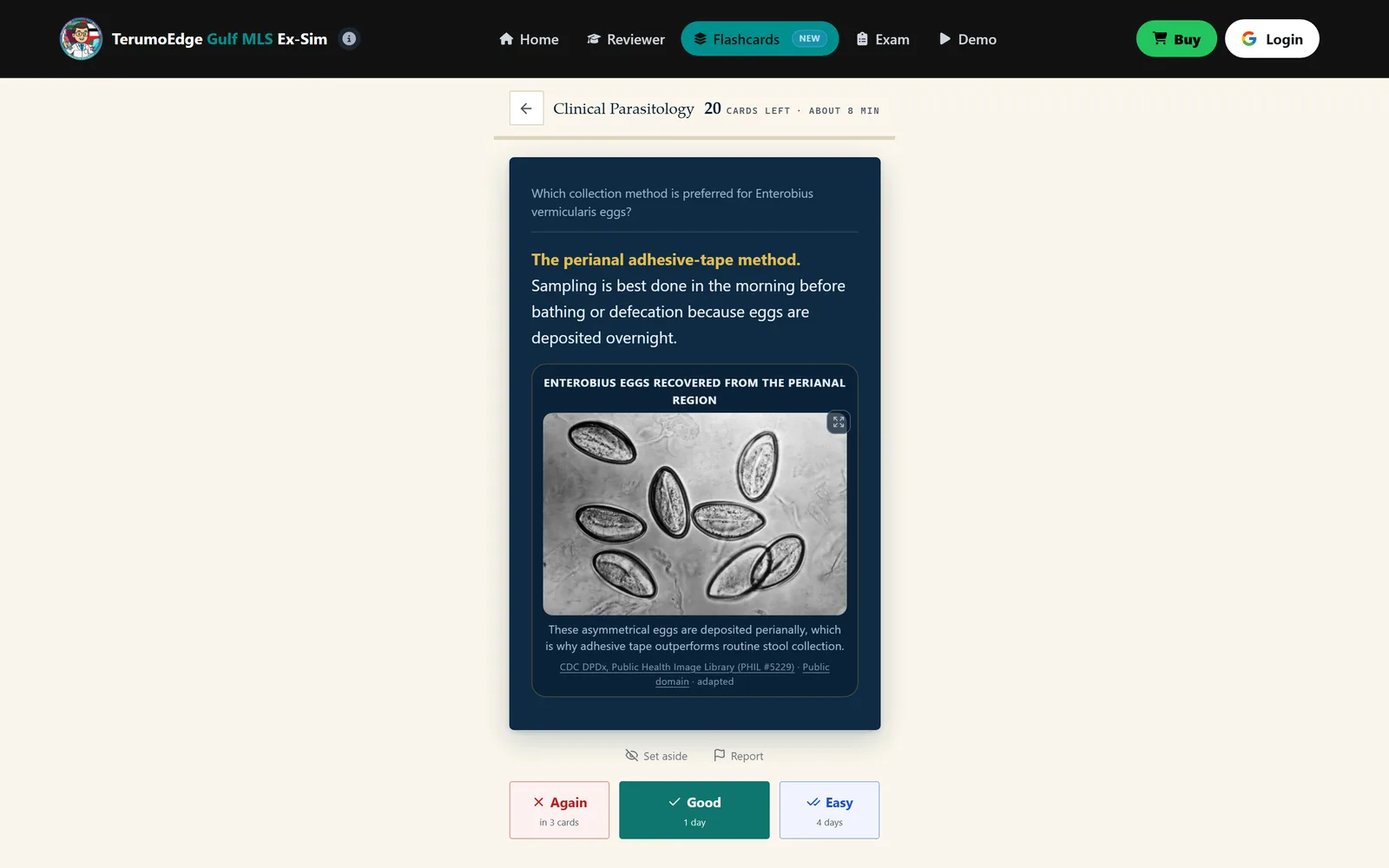
| Parasitology | 10% | Diagnostic stage and specimen for each parasite | Make stage and specimen cards |
How do you review microbiology for the Prometric exam, starting with bacteria by group?
Learn bacteria in groups that share a first test, because the first test removes half the options. Gram-positive cocci split on catalase: staphylococci are positive and streptococci are negative. Among staphylococci, coagulase separates S. aureus from the others.
Streptococci then split on haemolysis and a few discriminators. Group A is bacitracin-susceptible and PYR-positive, and group B is hippurate-positive and CAMP-positive. S. pneumoniae is optochin-susceptible and bile-soluble. Enterococci are PYR-positive, grow in bile esculin and tolerate 6.5% NaCl.
For Gram-negative rods, oxidase is the first fork. Enterobacterales (the E. coli family) are oxidase-negative glucose fermenters. Lactose fermenters on MacConkey agar include E. coli and Klebsiella; non-fermenters include Salmonella, Shigella and Proteus. Pseudomonas is oxidase-positive and a non-fermenter.
Why does the specimen matter before any test starts?
A culture result is only as good as the specimen, so exam stems often hide the error in collection or transport. Blood cultures are drawn as separate sets from separate sites, before antibiotics where possible, to separate a true bloodstream infection from skin contamination. A urine culture wants a clean-catch midstream sample, processed promptly or kept refrigerated, because organisms keep multiplying at room temperature.
Fragile organisms add their own rules. Neisseria meningitidis and Haemophilus in CSF die in the cold, so CSF for culture is not refrigerated. Anaerobes need an oxygen-free transport container. A stool culture for parasites may need preservative or several samples on different days, because shedding is intermittent.
When you read a stem, ask first whether the specimen could be the problem. A mixed growth of many colony types from a poorly collected sample points to contamination, not to a polymicrobial infection. Our SCFHS exam guide shows where each paper places these skills.
How do identification and susceptibility testing work?
Identification and susceptibility are two separate questions, and the exam tests them separately. Identification asks who the organism is, using stain, colony appearance, biochemical tests and sometimes serotyping. Susceptibility asks what kills it.
For disc diffusion, you spread a standardised inoculum (a 0.5 McFarland suspension) on Mueller-Hinton agar, apply discs and measure the zones of inhibition. A larger zone generally means more susceptible, but the cut-offs are drug-and-organism specific, so read them from the interpretive table rather than guessing. The minimum inhibitory concentration (MIC) is the lowest drug concentration that prevents visible growth.
Know the resistance patterns that matter: MRSA, usually screened with cefoxitin, and ESBL production in Enterobacterales. Know the quality-control logic too: reference strains are tested alongside patient isolates, and a control out of range means the patient result is not reported until the problem is fixed.
What mycology and virology should you review?
Mycology and virology are small, high-yield blocks: 10% each on the SCFHS Microbiology Technician paper. Keep both comparative.
For fungi, a positive germ tube test separates Candida albicans from other yeasts. Cryptococcus shows a capsule on India ink and is urease-positive. Dermatophytes are keratin-loving moulds named for the genus: Trichophyton, Microsporum and Epidermophyton. Dimorphic fungi grow as moulds at room temperature and as yeasts at body temperature.
For viruses, learn hepatitis B serology as a pattern. HBsAg means current infection. Anti-HBs means immunity. Anti-HBc IgM marks recent infection and can be the sole marker present in the window period.
How do you remember parasites by diagnostic stage?
Remember each parasite as a stage plus a specimen, because that is how the bench identifies it. A life-cycle diagram answers a different question from "what do I see on the slide".
| Parasite | Diagnostic stage | Specimen and method |
|---|---|---|
| Enterobius vermicularis | Eggs | Perianal adhesive-tape preparation |
| Ascaris lumbricoides | Fertilised eggs | Stool concentration |
| Hookworm | Eggs (larvae in old stool) | Stool, fresh |
| Strongyloides stercoralis | Larvae | Stool or concentration |
| Giardia lamblia | Cysts and trophozoites | Stool; trophozoites in loose stool |
| Entamoeba histolytica | Cysts with four nuclei | Stool, iodine mount |
| Plasmodium species | Rings, trophozoites, schizonts, gametocytes | Thick and thin blood films |
Pair look-alikes. The Entamoeba histolytica cyst has up to four nuclei and Entamoeba coli up to eight. Taenia saginata has more lateral uterine branches per proglottid than T. solium. Use the flashcards for this, since the Clinical Parasitology deck suits stage-and-specimen recall.
What about safety and QC on the micro paper?
On the Microbiology Technician paper, lab safety and QC together are 20%, which is more than most candidates budget for. Safety is procedure: biosafety cabinets for aerosol-producing work, standard precautions, correct waste segregation, autoclave sterilisation (commonly 121 degrees C under pressure) and spill management.
QC means every medium, stain and reagent is checked with known control organisms before use, and every result is traceable. If a control fails, the batch is not used. These are the same ideas the general technician paper tests under safety and QC, so the effort is not wasted if you sit the general paper.
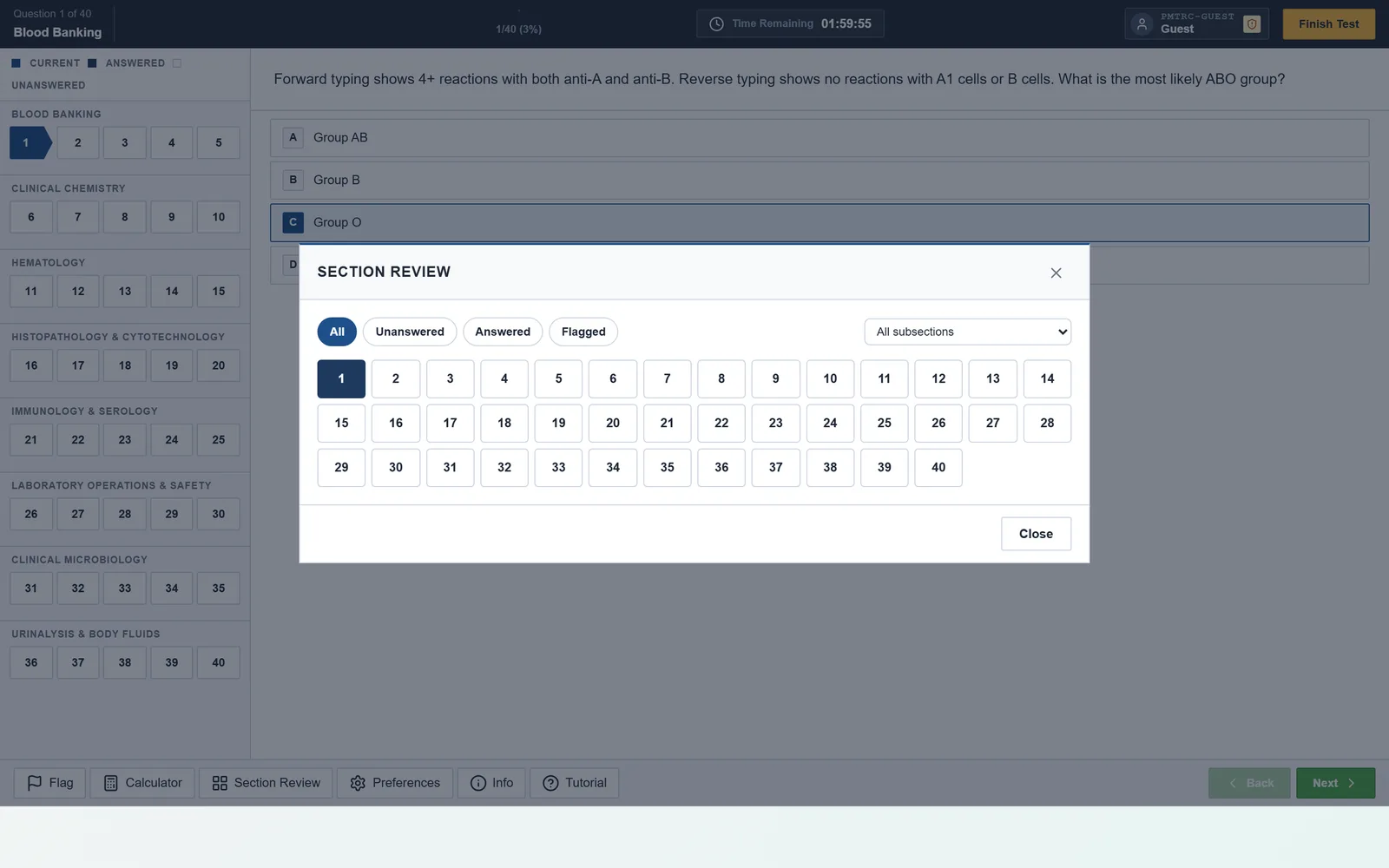
A two-week plan fits the weights. Give four days to bacteriology flows, two to susceptibility, two to mycology and virology, three to parasites, and the rest to safety, QC and timed sets. The bank has 500 Clinical Microbiology items, and a full session is 100 items. The wider eight-week plan shows where it fits, and the free demo gives a taste first.
Frequently asked questions
What is the SCFHS Microbiology Technician exam?
It is a separate SCFHS paper for Laboratory (Microbiology) Technicians: 150 MCQs in 3 hours with a 55% passing score, per SCFHS's content guideline. It covers lab safety, quality control, bacteriology, immunology and serology, virology, mycology and parasitology. Confirm current eligibility and rules with SCFHS.
How much of the Microbiology Technician exam is bacteriology?
Bacteriology is 40% of that paper, the largest single area. Lab safety, quality control, immunology and serology, virology, mycology and parasitology are 10% each. As with all SCFHS weights, check the current guideline, since distributions can change.
How do I remember parasite life cycles?
Do not try to hold the full cycle first. Fix the diagnostic stage and the specimen for each parasite, then add the infective stage and the route of infection. Use one card per parasite and test yourself in both directions: from the image to the name, and from the name to the specimen.
Is mycology worth the study time?
On the Microbiology Technician paper it is 10%, so yes. On the general technician paper it is part of a 20% microbiology block, so give it less time than bacteriology but not none. A few well-chosen comparisons cover most of what a mycology question asks.
Sources
- Laboratory Technician Blueprint (Saudi Licensing Examinations) - SCFHS
- Laboratory (Microbiology) Technician Content Guideline - SCFHS
- Saudi Laboratory Specialist Licensure Examination (SLLE) Content Guideline - SCFHS
- Healthcare Professional Licensing Assessment Guideline, Computer Based Testing - Dubai Health Authority
From the publisher
Practise the lab disciplines first.
TerumoEdge Gulf MLS is a practice simulator for the Gulf laboratory licensing exams: timed sessions in eight lab disciplines, an adjustable clock, and a full explanation for every item instead of a bare answer key.
- 4,000 items, 500 in each of eight lab disciplines
- A 100-item blended mock, reshuffled each attempt
- A full English explanation for every item, with the reason each wrong option is wrong
- A lab science reviewer and flashcards beside the question bank
Try the free Gulf MLS simulator demo Forty items across all eight lab disciplines. No account needed.
About this article
Written by the TerumoEdge editorial team, who build the TerumoEdge Gulf MLS Ex-Sim. Exam facts are checked against the published documents of SCFHS, the Dubai Health Authority, Qatar's Department of Healthcare Professions and NHRA Bahrain, and every article lists its sources. How we write and check our articles.
First published .