
Comparisons7-minute readFor medtechs reviewing from PDFs and recall lists
Prometric reviewer for medtech: PDFs, recall lists or a simulator for a Gulf exam
Compare a Prometric reviewer for medtech: PDF notes, recall lists and a simulator. See what each does well, what it cannot verify, and the order to use them.
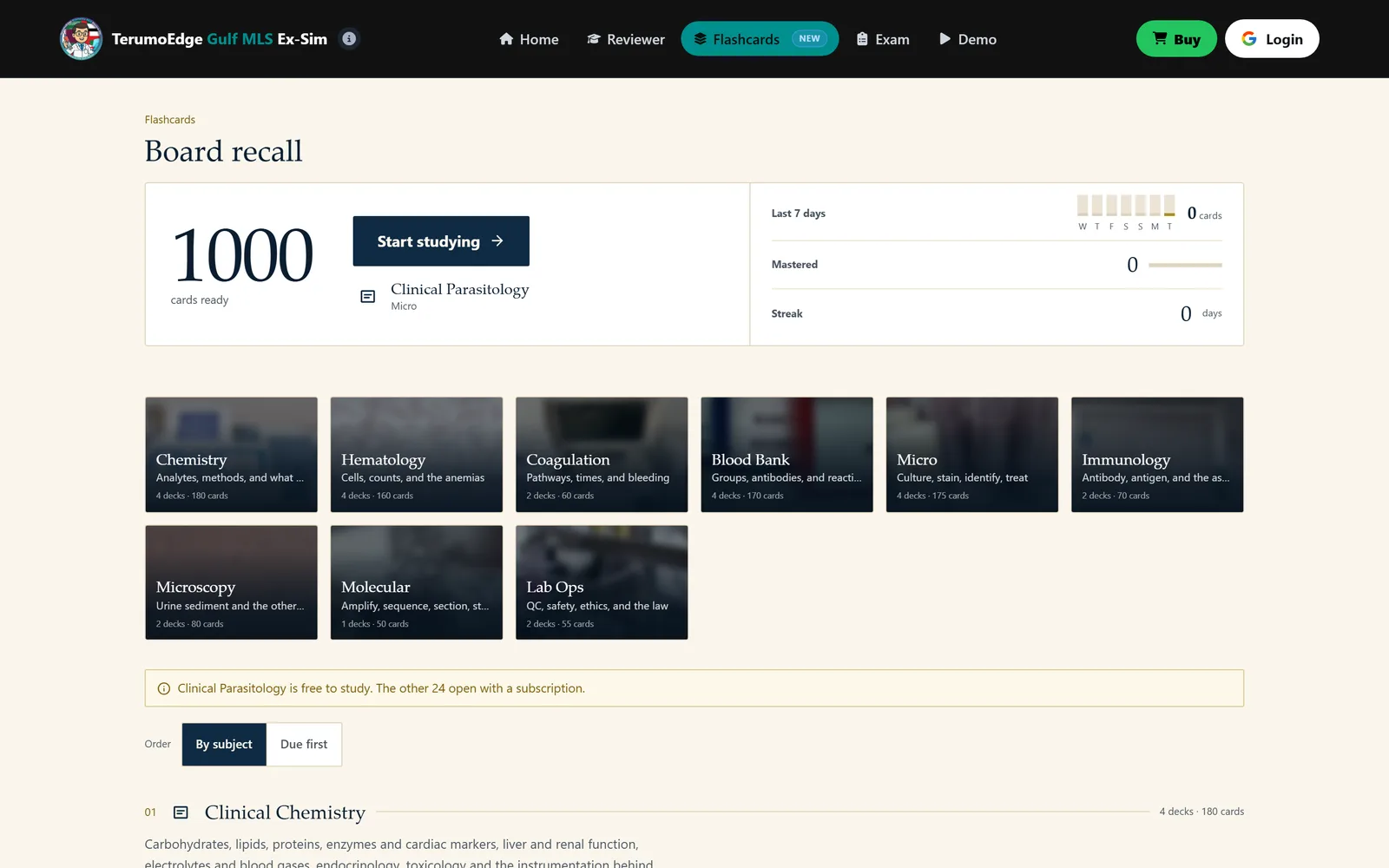
Every medtech preparing for a Gulf exam ends up with a folder of PDFs and, sooner or later, a "recall" list from someone who sat the paper. The question is how much weight each deserves next to a simulator. This guide compares the three kinds of Prometric reviewer for medtech use: what each does well, what it cannot do, and the order that makes the most of them.
We publish this blog and make the TerumoEdge Gulf MLS Ex-Sim, a simulator, so read our view of simulators with that in mind. We try to be fair to PDFs and to the people who share recall lists.
What is the short answer on a Prometric reviewer for medtech?
Use all three, in a sequence. Start with a PDF reviewer or notes for coverage, because you cannot practise what you have not learned. Check the facts that matter, such as the exam format and weights, against the authority's own document. Then use a simulator to turn knowledge into speed and accuracy under a clock.
Recall lists fit awkwardly in that sequence. They can tell you what kinds of topics candidates remember, but nobody can verify a list's origin, accuracy or currency, and it may reflect no authority's present blueprint. We make no claim about where any list comes from. We only say that you cannot check it, and that is a reason to hold it loosely.
There is also a human side to this. A recall list often arrives from a colleague who means well, and refusing it can feel rude. You do not have to refuse it. Read it as a prompt for topics, check each point against a textbook or the authority's document, and keep your preparation anchored to the blueprint instead. That way the list costs you nothing and may point you at a gap you had missed.
What does a PDF reviewer do well?
A PDF reviewer does one job well: it gives you a structured pass over the content. Good ones summarise a discipline's essentials, organise topics into manageable chunks and let you study offline on a phone between shifts.
They are cheap to share, quick to skim and easy to annotate. If you trained a few years ago, a reviewer is the fastest way to find which topics have gone cold. Careful authors state their source, their edition and the authority they target.
The weaknesses are predictable. A PDF cannot test you, so you cannot tell understanding from familiarity. It usually offers no timing and no feedback. Quality varies widely, and a PDF built for another exam or another year may carry outdated or mismatched content. Check the date, the author and whether it names the blueprint it follows.
A practical test: pick one topic you know well, such as a coagulation pathway, and read what the PDF says. If you find errors in the area you know, expect more in the areas you do not. If it is accurate and clearly organised, it earns a place in your plan. Either way, a reviewer on its own leaves a gap, which is that reading about a topic and answering a single-best-answer item on it are different skills.
Recall lists: what can they and cannot tell you?
A recall list can tell you which topics some candidates remembered. It cannot tell you whether the items are accurate, current or from your authority's paper.
Three limits matter. First, they are unverified: you cannot check the source or the correct answers. Second, they are unexplained: a remembered question without a rationale teaches a fact at best, and a wrong fact at worst. Third, they tie to no blueprint: the weights SCFHS publishes, for example, may change at any time, with each category varying by up to 5% (SCFHS technician blueprint).
Recalls also push you toward memorising answers instead of learning the reasoning that transfers to a new item. If a list prompts you to look something up, that is useful. If it replaces study, it is risky.
What does a simulator add?
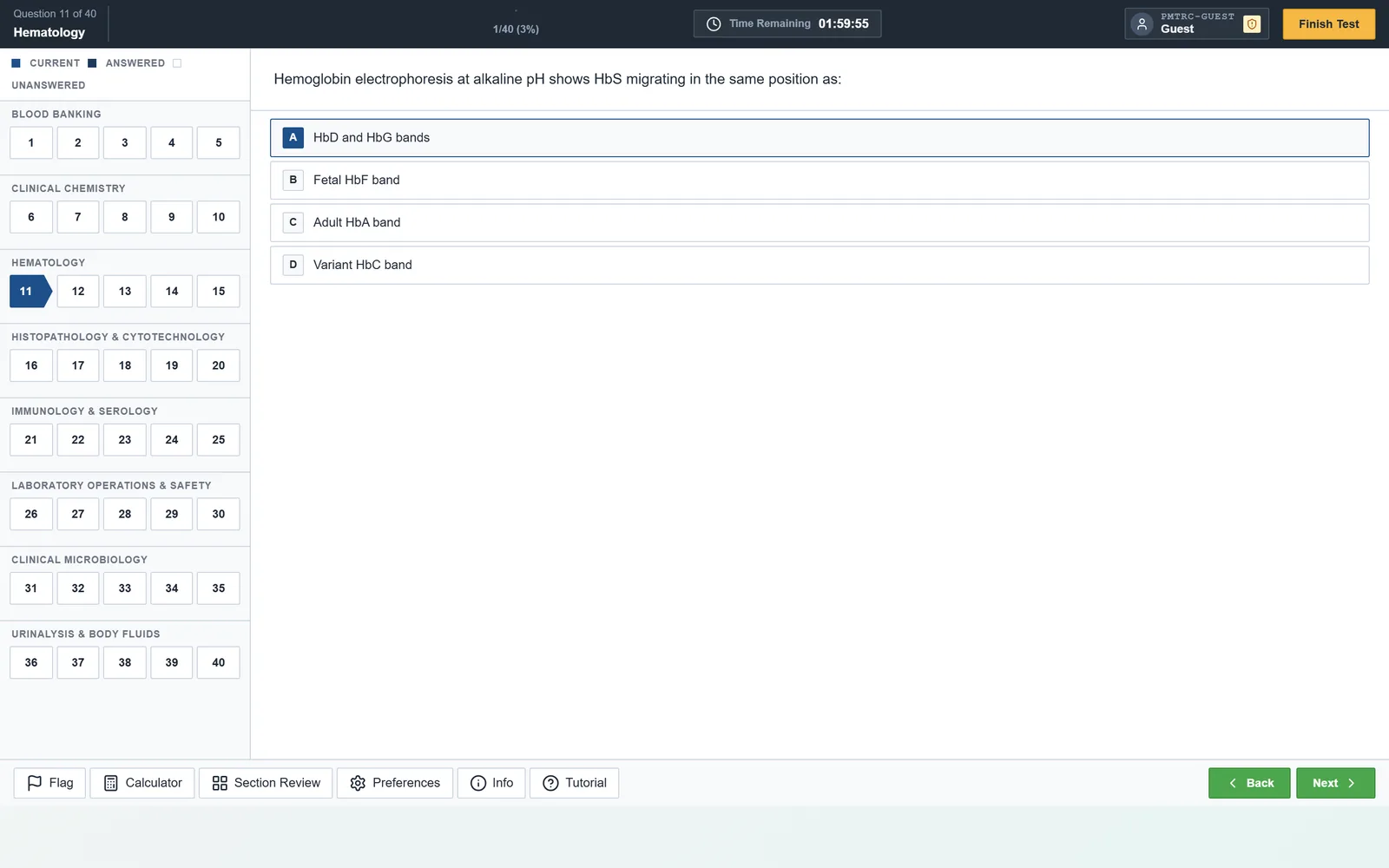
A simulator adds the three things the other tools lack: a clock, a format and explanations.
The clock reveals your pace. A 150-item, 3-hour paper leaves 72 seconds an item, and many candidates discover only in a timed session that their pace is the problem. The format is single-best-answer with four options, as the SCFHS specialist guide describes (SLLE guideline), and practice teaches you to choose between two plausible options. The explanations turn mistakes into learning.
In TerumoEdge, every item has an English explanation that names the correct answer, gives the rationale, says why each other option is wrong and carries reference citations. The free demo does not show those explanations, so you cannot check them there. What it shows is the exam room and the item format. We cover the product in full in what a Gulf Prometric MLS simulator is.
Comparing the three tools
| Factor | PDF reviewer | Recall list | Simulator |
|---|---|---|---|
| Coverage | Broad, if well made | Patchy, whatever people remember | Broad across disciplines; one fixed blend in a mock |
| Accuracy check | Depends on the author; check source and date | Cannot be verified | Depends on the bank; look for cited references |
| Explanations | Usually notes, not item-level | Rarely any | Item-level, if the product provides them |
| Timing | None | None | Clock on every session |
| Blueprint fit | Only if it names one | None | Adjust clock and focus to your authority |
None of the three replaces your authority's guide. Read that first, because it is the one document that describes your exam.
Which official reference lists are worth reading?
Start with the authority's own documents: SCFHS publishes blueprints and content guidelines, DHA publishes a CBT guideline with coverage lists, and Qatar's DHP publishes a qualifying exam page. For Bahrain, NHRA publishes "Medical Laboratory Technologist Examination References", which it says it extracted from the SCFHS website, and it states that exam questions may not necessarily be taken solely from these references (NHRA licensure exams page).
That caveat is useful for every reference list. A list tells you where to start, not the limits of the paper. NHRA's page gives no question count, time or pass mark, so check with NHRA for those. For the other authorities, the figures we could verify are in Gulf lab licensing exams compared.
In what order should you use all three?
Use coverage, then verification, then timed practice, and loop back as needed.
A simulator is not the only tool in the third step. Our guide to choosing a reviewer app lists nine criteria for judging any practice tool, and ChatGPT for Prometric exam prep explains where chatbots fit. Here is the sequence in full.
- Coverage. Work through a reviewer or notes by discipline, using your authority's blueprint to decide how long each gets.
- Verification. Check any surprising fact against an official document or a standard textbook, especially anything from a recall list.
- Timed practice. Move to timed discipline sessions, then full mocks at exam pace, and read every explanation, including for items you got right.
- Repair. Send each miss back to coverage, and use flashcards for short-gap recall of facts that keep slipping.
Each loop gets shorter. Early on, you may spend a week on coverage before your first timed session. By the final month, a day's work might be one timed discipline set, a close read of the explanations and a flashcard pass on what slipped. The tools stay the same; the proportions shift from reading toward practice as the exam nears.
Frequently asked questions
Are Prometric recalls reliable?
Nobody can verify them. We make no claim about where any list comes from. What we can say is that a recall list has no stated source, no explanations and no link to your authority's current blueprint, so treat anything in it as unconfirmed until you check it against an official document or a textbook.
Is a PDF reviewer enough on its own?
For some people it is enough for coverage, but it does not test speed or the single-best-answer format. Add timed practice before exam day, so you learn your pace and your weak disciplines while there is still time to fix them.
What references does NHRA list?
NHRA Bahrain publishes a page of Medical Laboratory Technologist examination references that it says were extracted from the SCFHS website. It also says questions may not necessarily be taken solely from them. The page gives no item count, time or pass mark, so check with NHRA.
Sources
From the publisher
Practise the lab disciplines first.
TerumoEdge Gulf MLS is a practice simulator for the Gulf laboratory licensing exams: timed sessions in eight lab disciplines, an adjustable clock, and a full explanation for every item instead of a bare answer key.
- 4,000 items, 500 in each of eight lab disciplines
- A 100-item blended mock, reshuffled each attempt
- A full English explanation for every item, with the reason each wrong option is wrong
- A lab science reviewer and flashcards beside the question bank
Try the free Gulf MLS simulator demo Forty items across all eight lab disciplines. No account needed.
About this article
Written by the TerumoEdge editorial team, who build the TerumoEdge Gulf MLS Ex-Sim. Exam facts are checked against the published documents of SCFHS, the Dubai Health Authority, Qatar's Department of Healthcare Professions and NHRA Bahrain, and every article lists its sources. How we write and check our articles.
First published .